

Annie doesn’t think of math as something you either have or you don’t. But she creates spaces for young people where curiosity is treasured and mistakes are expected.
It’s a summer afternoon in Laramie and a group of young people is gathered on the tennis courts. But they’re not playing tennis! They’re taking a break from practicing serving skills to using math skills to make a deeper connection to their tennis environment. They learn the spatial dimensions of their playing area by actually measuring lines and counting rectangles. By launching rockets at different angles across the net they learn to apply the same knowledge to angle their rackets when hitting balls. Tennis becomes a fun way to use their math brain to keep track of numbers whether it is scoring points or keeping track of team or individual totals in relays or when hitting targets
Try This: Destination Woodshop: This University of Wyoming Wyrkshop activity was recommended by Goshen County’s Summer Break. It is appropriate for young learners. Download the guide and find the activity on page 8. Simply use a ruler-printout to explore your space!
The person behind this mix of STEM and tennis is Annie Bergman, Ph.D. At the University of Wyoming. She wears many hats as the INBRE Student Research Program Director, UW STEAM Camps Director, INBRE/Space Grant Consortium Science Kitchen Co-Director, and a National Jr. Tennis & Learning coach instructor. In her many roles, she mentors undergraduate and graduate students. She helps them by facilitating a program focused on developing their resilience and wellbeing. She coaches them through challenges they don’t always feel prepared for, like giving a presentation, navigating feedback, and finding their footing in demanding academic spaces.
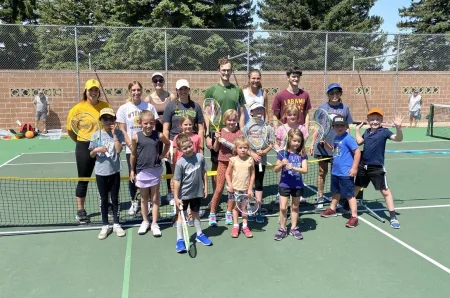
Annie encourages everyone to stretch, physically and mentally: “I tell my students and young tennis players all the time—they’re not going to learn anything unless they fail.” But she doesn’t stop at the stumble. Annie makes sure that when young people hit a wall, there’s something on the other side: a question to ask, a peer to lean on, a new way in, and resources to help.
A strong belief in failure, paired with an instinct to meet people where they are, is what makes Annie a force in the lives of so many young people. Whether she’s working with college students or four-year-olds picking up a tennis racket for the first time, her goal is to help them feel comfortable enough to try, to struggle, and to keep going.
Annie teaches young people to build their own mentor mindset by practicing coaching themselves. Instead of “I can’t do this,” she encourages them to use a different voice that sounds more like a coach than a critic. That voice says, “You can do this.”
Try This: Help shift a young person’s inner voice.
Instead of: “I can’t do this.”
Try: You can do this.”
Annie uses this approach to turn self-doubt into support.
Young people often have an inner voice that says, “You missed that ball, you might as well quit.” Or, “You had the wrong answer on your math test, you’re never going to be good at math.” Annie characterizes that voice as the “jackal” and asks the young person to name it. One little girl named her inner critic “Miss Sassypants.” Annie then asks them to name the friendly voice that counters it. The exercise is playful – and that’s the point. When a child can laugh at “Miss Sassypants,” the inner critic loses a little of its power. She emphasizes that struggling doesn’t mean you lack ability. It means you need support. And it means you’re learning.
Annie approaches this work with experience. As a child, she loved algebra and geometry. But when she reached calculus in college, everything changed: “I only understood it while I was in class but on my own, I didn’t even understand what I was looking at.” But she didn’t walk away from learning. Today, Annie doesn’t let her students walk away either. Her own stumble in calculus is something she shares openly — not as a cautionary tale, but as proof that confusion is a starting point, not a verdict.
“The kids know ‘yet’ at any age. They know all about the growth mindset.” She notes that they’ll reinforce the idea by saying, “I haven’t learned it ‘yet.’” And they understand how to treat getting ‘stuck’ as more of a pause and a chance to reflect.
Annie is someone who doesn’t see herself as a math hero, but she understands the power of mentorship, building relationships, and helping young people do hard things. She also knows the power of bringing people onto her team who can add their talents. She noted that her favorite part of this work “isn’t necessarily doing every activity because I have people helping me who know better.” Instead, she thrives on curiosity: “That’s the part I like—brainstorming, creative stuff.” Bringing in medical students and college students to help teach STEM and coach tennis has been wonderful to see the young faces light up and hear from the instructors how much it meant to be able to have fun engaging with the youth.
At the heart of this work, Annie’s teaching philosophy is coaching – helping young people to see struggle not as a dead end, but as a direction: the signal that it’s time to ask, to lean on someone, and to keep going — together.
Back to all articles

